
The world
The world of Anatomy of Mercy
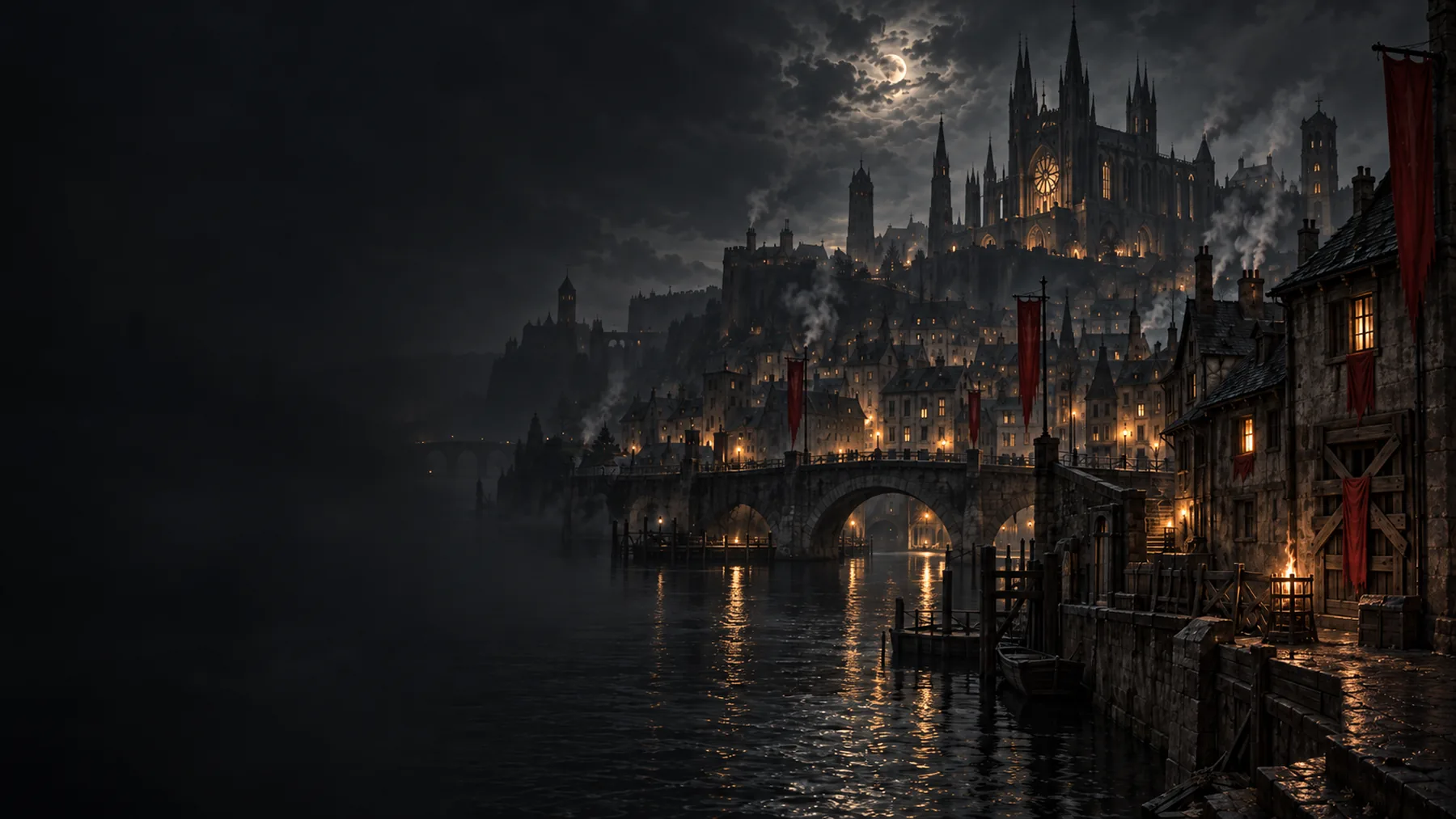
A city that grew rich on trade, pilgrimage and medicine, now sealed shut by its own quarantine. Three names for one disease. One Church that feeds the sick and burns their streets.
Vespera
A sealed street is not an empty street.
Vespera is a late medieval city of steep roofs, narrow lanes, canals and stone bridges, under a cathedral that dominates every view it appears in. Its wealth came from goods that passed through it, pilgrims who stopped in it, and a school of medicine whose name outlived the reputation of everyone who taught there.
Keep reading
The plague changed who gives orders. Secular authority still exists and still signs documents, but it is weak. The Church of Light holds executive power: it decides which gates close, which houses are marked and which streets are cleansed. Experimental treatment has been forbidden since a handful of well documented disasters.
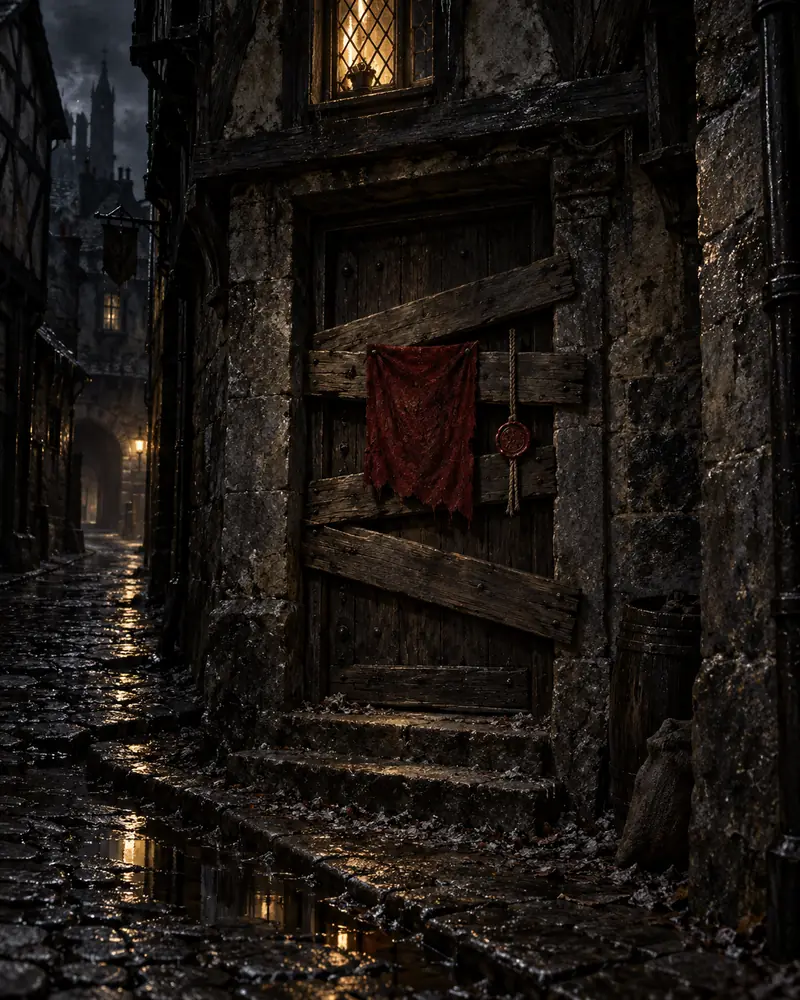
Quarantine is visible from the street. Timber barriers stand across the lanes, doors are sealed and marked with red cloth, barrels of resin wait against the walls of a district scheduled to burn, and ash falls over all of it like dirty snow. People live behind the barriers, and they can hear the bell.
By city law a body belongs to the family. The Church may take it anyway, as a sanitary hazard. Bone and blood carry medical, religious and commercial value at the same time, which is why there is a market for both that nobody admits to.
The Crimson Plague
It does not kill quickly. First it takes whatever made the person recognisable.
Three names for one disease, and the one a person uses tells you where they stand. Most call it the Crimson Plague. The Church calls it the Crimson Blemish, a sickness of the body that works through the cracks in a person's character. Julian calls it blood crystallica and declines the rest.
How it advances
- Latency Weakness, fever, and eyes that cannot bear bright light.
- Blood change Dark veins, bleeding that will not stop when it should, and a temper in which the old person is harder and harder to find.
- Crystallisation Pain in the bones, stiffness, red deposits under the skin. This is the stage a physician can still act on.
- Resonance Hallucinations, images shared with other sick people, and the loss of one's own will.
Keep reading
It passes through blood and bodily fluids. Standing near a sick person is not enough to catch it. What is dangerous is an open wound, a spill, and above all dust: in the late stages the disease grows crystalline deposits in vessels and marrow, and broken crystal sheds a dust that infects whoever breathes it.
This is why fire is not a clean answer. Flame destroys active tissue, but inside a closed room it spreads the dust before it burns it. A controlled cleansing means evacuating the building, sealing the rooms, binding the dust with a reagent and burning outward from the source. The Church knows this. It does not always have the time.
Removing the affected tissue and setting a living, compatible bone and marrow graft in its place can stop some forms of the disease. The material may be taken from a living donor or someone recently dead; how it is obtained leaves its mark on those who survive. Where the plague came from in the first place is not known, and the physicians of Vespera have stopped pretending otherwise.
The Church of Light
Every gate in Vespera was closed by someone who believed it would save more people than it killed.
The Church of Light feeds the sick, nurses them, buries them, keeps the quarantine and keeps order. It also runs an apparatus of coercion that can justify almost anything by pointing at the majority it protects. Both halves are true at once, and nothing on this page is going to resolve that for you.
Four structures, one institution
- The Synod of Light The highest authority in Vespera. Sets doctrine, holds the property and negotiates with what is left of the secular city.
- The Order of the Lantern Runs the wards, the kitchens and the almshouses. Nursing sisters in dark habits and stained aprons, a lantern in one hand and a list of names in the other. Some consider Julian a heretic. Some use his methods quietly.
- The Holy Office Investigates and judges: heresy, illegal autopsies, broken quarantine, experiments. Dangerous through procedure and certainty rather than through cruelty.
- The Inquisition Carries the sentences out. Guards the wards, seals the districts, conducts the cleansings. The plain white masks and dark coats are worn by fanatics, professional soldiers, people who lost their families, and people trying to blunt the orders they were given.
Keep reading
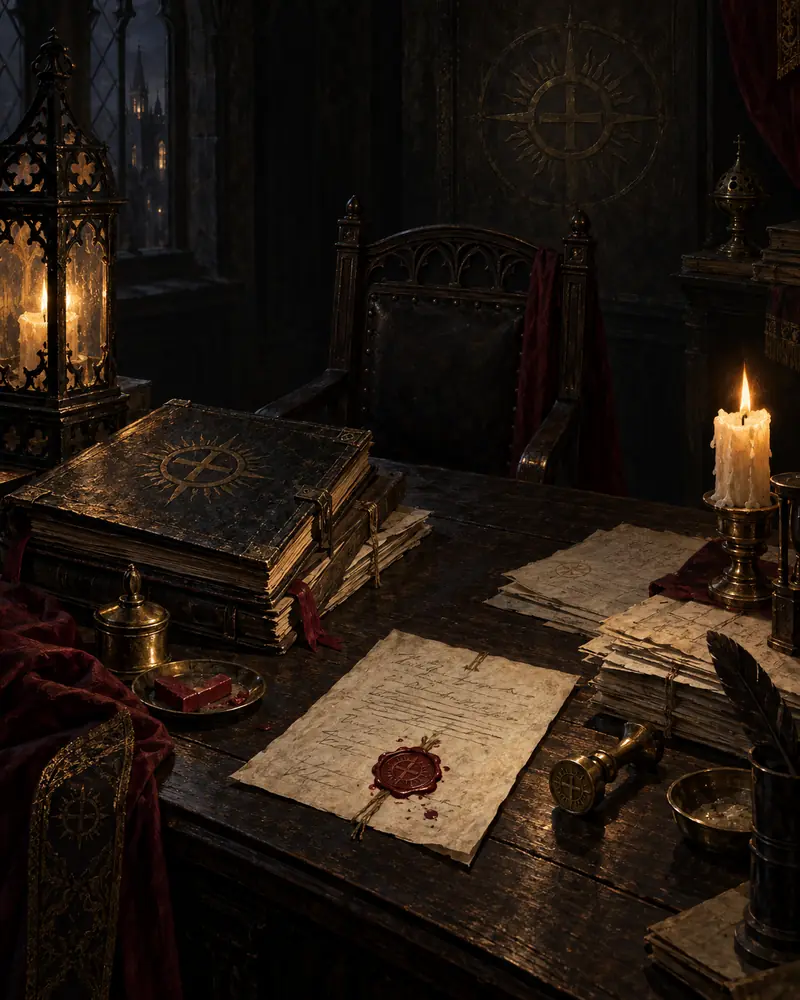
Its doctrine holds that Light is truth, order and cleansing, and that the Blemish is a disease of the body that exploits a person's moral fractures. Not every cleric reads that literally. The sign of the Church is a sun cross inside a circle, worn on aprons, banners, seals and armour.
The Church holds part of the truth. Isolation does limit infection, fire does destroy active tissue, and some of Julian's experiments really do raise the risk of mutation. It also crosses lines: infection is read as evidence of guilt, sentences are passed on incomplete diagnoses, quarantine serves political control, and the institution hides its own mistakes to keep its authority.
The objects that keep coming back
In Vespera an object usually means that a decision about someone has already been made. These ten come back constantly: in the wards, in the paperwork, and in the physician's own bag.
- A thin metal rod for percussing bone, worn smooth by years of use.
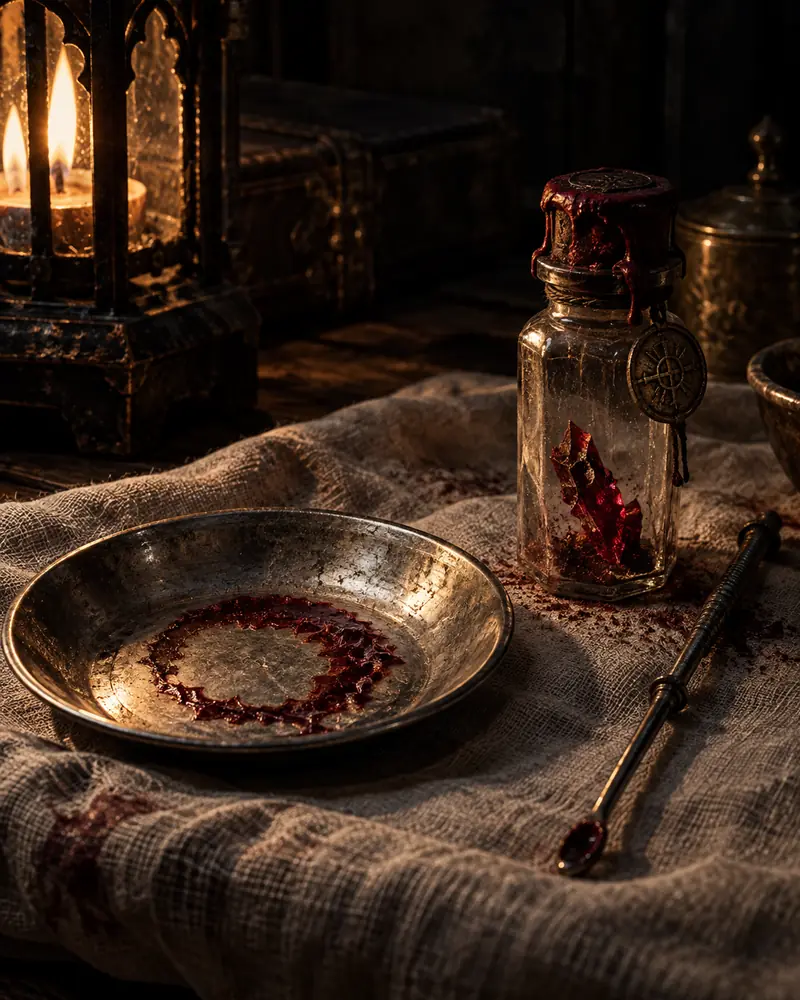
- Small glass vials, waxed and sealed. In some of them, something moves.
- A silver plate on which you find out whether blood will clot.
- A roll of surgical instruments in leather, laid open on clean cloth.
- An extraction card: a donor's name, a note on compatibility, and one word everything rests on.
- Seals, wax, and deferrals bearing a commander's stamp.
- Lanterns of wrought iron, carried by people who are not allowed to put them down.
- Red banners on poles, and red cloth nailed to a sealed door.
- Barrels of resin, the sign that a district is going up in smoke.
- A bell. Three strikes mean the street is burning.
If I start dying, Julian will do everything he knows how to do. But will he ask what I want?
Four people lived through one night of this and wrote it down afterwards. Each of them is certain about something the others remember differently.
The stories